Causes for Different Spatial Distributions of Minimum Arctic Sea-Ice Extent in 2007 and 2012
摘要
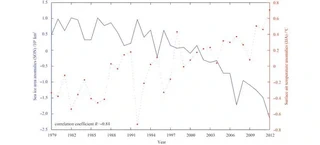
Satellite records show the minimum Arctic sea ice extents (SIEs) were observed in the Septembers of 2007 and 2012, but the spatial distributions of sea ice concentration reductlon in these two years were quite different. Atmospheric circulation pattern and the upper-ocean state in summer were Investigated to explain the dlfference.By employing the ice-temperature and ice-specific humidity (SH) positive feedbacks in the Arctic Ocean, this paper shows that in 2007 and 2012 the higher surface air temperature (SAT) and sea level pressure (SLP)accompanied by more surface SH and higher sea surface temperature (SST), as a coasequence, the strengchened poleward wind was favorable for melting summer Arctic sea ice in different regions in these two years. SAT was the dominant factor Influencing the distribution of Arctic sea Ice melting. The correlation coeificient is -0.84between SAT anomalies in summer and the Arctic SIE anomalies in autumn. The increase SAT in different regions in the summers of 2007 and 2012 corresponded to a quicker melting of sea ice in the Arctic. The SLP and related wind were promoting factors connected with SAT. Surengthening poleward winds brought warm moist air to the Arctic and accelerated the melting of sea ice in different reglons in the summers of 2007 and 2012. Associated wich the rising air temperature, the higher surface SH and SST also played a positlve role in reducing summer Arctic sea ice in diferent regions in these two years, which form two positive feedbacks nechanism.
类型
出版物
Acta Oceanologica Sinica