DOA Estimation of Underwater Acoustic Array Signal Based on Wavelet Transform with Double branch Convolutional Neural Network
2022年11月6日·,,,,
JingJing Wang
Tianqi Quan
Corresponding
,Lulu Jiao
Weilong Zhang
T. Aaron Gullive
Xinghai Yang
Corresponding
·
0 分钟阅读时长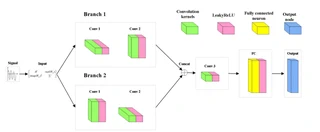
摘要
In underwater acoustic communications, a hydrophone array is often used to receive the underwater acoustic signals to improve the gain of the received signal. The direction of arrival (DOA) estimation is a basic task in underwater acoustic array signal processing. In underwater signal transmission, due to the channel complexity, a large signal transmission loss, and heavy noise interference, the received signal is seriously distorted, and the DOA estimation is poor. In order to improve the accuracy of DOA estimation for underwater acoustic array signals, this work proposes a continuous wavelet transform with convolutional neural network (CWT-CNN) method. A linear factor is used to improve the calculation process of continuous wavelet transform. The time-frequency fusion characteristics of signals are calculated by constructing a time-frequency array model with modified wavelet factors, and the fused features are used to train the proposed double branch CNN. Compared with other neural network-based DOA algorithms, the proposed algorithm improves the accuracy by 5%–20% and reduces the RMSE by 0.479°–1.172° under 7 different SNR conditions. In addition, the proposed algorithm has lower computational complexity.
类型
出版物
IEEE Transactions on Vehicular Technology
Authors
Authors
Authors
Authors
Authors
Authors