Two-stage Hydroacoustic Signal Demodulation Based on Attention and Generative Lightweight Folding U-network
摘要
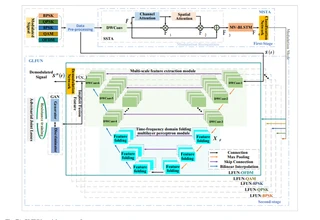
Hydroacoustic signal demodulation plays a crucial role in underwater communication systems. Recently, deep learning-based methods have gained popularity due to their ability to operate without precise channel state information. However, most existing algorithms are limited to demodulating specific modulation types, suffer from high computational complexity, and exhibit poor robustness in noise, multipath, and Doppler environments, and the current end-to-end signal demodulation neural network structure is redundant and has confusing functions, making them unsuitable for real-time and accurate communication. To address these challenges, this paper presents a two-stage demodulation method based on attention and generative lightweight folding U-network (TA-GLFUN), which combines the functions of signal modulation mode identification and demodulation. The neural network structure is decoupled according to the internal functions, achieving a demodulation neural network with clear functions and a simple structure in complex marine environments. In the first stage, the multitemporal scale spatio-temporal attention (MSTA) module identifies the modulation type of the input signals, enabling effective differentiation across multiple modulated signals. In the second stage, the generative lightweight folding U-network (GLFUN) extracts multiscale features efficiently, reducing model complexity and allowing for fast and accurate demodulation. Additionally, integrating a Generative Adversarial Network (GAN) and an Adversarial Joint Loss Strategy strengthens the model’s noise resilience and robustness. Experimental results show that TA-GLFUN achieves high accuracy in demodulating multiple modulation types, maintaining reliability even in complex underwater noise environments.
类型