Modeling and Optimal Control of Spatiotemporal Malware Propagation in Underwater Wireless Sensor Networks
摘要
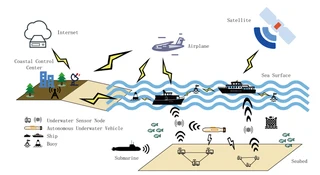
Underwater wireless sensor networks (UWSNs) have been shown to overcome the environmental extremes and energy dependency issues faced by traditional IoT in marine environments, leading to rapid development in fields such as environmental monitoring and disaster warning. Among these, autonomous underwater vehicles (AUVs) play a pivotal role in UWSNs. However, the mobility of AUVs poses significant challenges in detecting and controlling infected nodes due to the randomization of malicious program cross-platform infection and propagation paths. Accordingly, a mathematical model centered on the framework of epidemic theory has been proposed to study the propagation patterns of malicious programs in two coupled networks (AUVs and UWSNs). This model utilizes the mutual infection coefficient between AUVs and UWSNs to represent the cross-infection of malicious programs. In order to investigate the impact of AUV mobility on malware propagation, an improved cellular automaton model is proposed. This model combines the state transitions of epidemic theory with the cellular automaton model to represent the spatiotemporal propagation of malware. Furthermore, to attain optimal decision-making under resource constraints, we propose an optimization problem combining a mathematical model with defense strategies and use the sand dune cat swarm optimization (SCSO) algorithm to obtain the optimal control strategy. Finally, simulation experiments demonstrate that AUV movement and expanded communication radii exacerbate malware propagation, while also validating the influence of the basic reproduction number (R₀) on malware propagation and the inhibitory effect of optimal control strategies on malware propagation.
类型
出版物
IEEE Internet of Things Journal