Peak Colocalized Orthogonal Matching Pursuit for Seismic Trace Decomposition

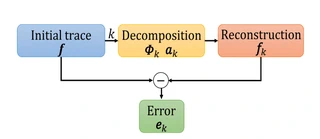 Image credit: Yongqing Li
摘要
Orthogonal matching pursuit (OMP) is an efficient method for decomposing a seismic trace with regard to an atom dictionary. The original OMP optimizes one unique single objective in terms of successively maximizing the inner product between an atom and its corresponding residual at different approximating levels. Though the inner product effectively measures signal similarity at a global time scale, it tends to neglect localizing an atom whose peak position plays a key role in seismic reconstruction. To address this limitation, we propose a peak colocalized orthogonal matching pursuit (PCOMP) strategy that optimizes two objectives, i.e., signal correlation and peak colocalization, both of which are defined based on signal residuals and atoms. Compared with the original OMP, the PCOMP extends a much larger search space in favor of more accurate seismic reconstruction. In this scenario, the genetic algorithm (GA) used for solving the original OMP is not suitable for the PCOMP. Therefore, we propose to solve the two objective optimization problem by exploiting an improved nondominated sorting genetic algorithm (NSGA-II) algorithm, which not only increases the diversity of searching for optimization and but also reduces the reconstruction error over the GA. Furthermore, the constrained atom positions obtained from the peak colocalization objective enable efficient convergence. Experiments for seismic data validate the advantages of the proposed PCOMP.
类型
出版物
IEEE Access
