Oil spill detection with multiscale conditional adversarial networks with small-data training

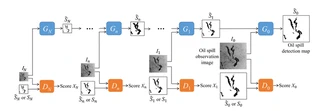 Image credit: Yongqing Li
摘要
We investigate the problem of training an oil spill detection model with small data. Most existing machine-learning-based oil spill detection models rely heavily on big training data. However, big amounts of oil spill observation data are difficult to access in practice. To address this limitation, we developed a multiscale conditional adversarial network (MCAN) consisting of a series of adversarial networks at multiple scales. The adversarial network at each scale consists of a generator and a discriminator. The generator aims at producing an oil spill detection map as authentically as possible. The discriminator tries its best to distinguish the generated detection map from the reference data. The training procedure of MCAN commences at the coarsest scale and operates in a coarse-to-fine fashion. The multiscale architecture comprehensively captures both global and local oil spill characteristics, and the adversarial training enhances the model’s representational power via the generated data. These properties empower the MCAN with the capability of learning with small oil spill observation data. Empirical evaluations validate that our MCAN trained with four oil spill observation images accurately detects oil spills in new images.
类型
出版物
Remote Sensing

Authors
Authors
Authors