Oil Spill Timely Backtracking Oriented by Wind Field Correction With Self-Attention Temporal Convolutional Networks

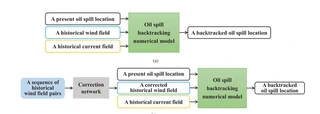 Image credit: Yongqing Li
摘要
We investigate the problem of oil spill timely backtracking. Most existing methods for backtracking oil spills rely heavily on historical wind fields. However, during the crucial early stages of an oil spill accident, only inaccurate forecasted or observed wind fields are available as historical data, which do not guarantee reliable accuracy for backtracking the oil spills. On the other hand, reanalysis wind fields are more accurate data for the historical wind fields. However, they normally have a latency of many days and can hardly be used for backtracking the oil spills in a timely manner. To obtain a timely and accurate estimate of the historical wind fields, we develop a self-attention temporal convolutional network (SaTCN). The SaTCN consists of a self-attention network and a temporal convolutional network. The self-attention network captures spatial correlations from a historical wind field sequence in a global manner. The temporal convolutional network captures spatial correlations and temporal characteristics from an attention-weighted wind field sequence in a local manner. The SaTCN is trained subject to the differences between the timely but inaccurate data of both forecasted and observed wind fields and the accurate but delayed data of reanalysis wind fields. The well-trained SaTCN can correct the timely historical wind fields into more accurate ones by approximating the reanalysis wind fields. The corrected historical wind fields thus obtained enable timely, accurate oil spill backtracking. Extensive experiments validate the effectiveness of the proposed backtracking method in addressing the Sanchi and Symphony oil spill accidents.
类型
出版物
IEEE Journal of Oceanic Engineering

Authors
Authors