Reconstructing three-dimensional density from surface data in the North Atlantic Sea through the PIO-Net model

摘要
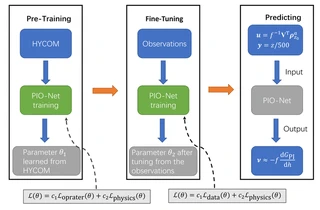
This study evaluates the applicability of the physics-informed operator network (PIO-Net) for reconstructing subsurface density anomalies (SDAs) based on sea surface density. PIO-Net approximates the density field by representing SDAs as a linear combination of reduced-basis, integrating physical constraints by the quasi-geostrophy theory while reducing computational costs. Nevertheless, the original PIO-Net can only tackle the gridded data, contradicting to the fact that the in-situ observations in the vertical column is sparse. To address this limitation, the network’s loss function is modified to the mean squared error between the interpolation-based reconstruction and observations. Furthermore, we propose a transfer learning strategy that involves pre-training the model on reanalysis data and subsequently fine-tuning it with sparse Argo observations using the adapted loss function. Validation with independent Argo observations shows that the reconstructed SDAs align well with in situ measurements, with improved accuracy in data-sparse regions. Comparative analyses between the PIO-Net and publicly available grided Argo products exhibit that PIO-Net achieves the accuracy at same order, but with resolution as high as request. In addition, the case study illustrates the PIO-Net outperforms purely data-driven models such as Long Short-Term Memory network and feedforward neural networks. Finally, potential error sources and future extensions are discussed.
类型
出版物
Ocean Engineering
